


CTAL-TM-001 PDF Dumps Real 2026 Recently Updated Questions
Released ISTQB CTAL-TM-001 Updated Questions PDF
CTAL-TM Certification Path
6 months of experience in Software development/software testing. Successful completion of the ISTQB Certified Tester Foundation level and a minimum of three years testing experience is recommended. The Intermediate Certificate may also be helpful but is not required.
For more info visit:
NEW QUESTION # 107
Explain how the above mentioned report may differ from a report that you produce for the project manager, who is a test specialist Select TWO items from the following options that can be used to report to the project manager and would not be included in a report to senior management. 1 credit
- A. State recommendations for release
- B. Show details on effort spent
- C. List of all outstanding defects with their priority and severity
- D. Give product risk status
- E. Show trend analysis
Answer: B,C
NEW QUESTION # 108
Consider the typical objectives of testing. Which of the following metrics can be used to measure the effectiveness of the testing process in achieving one of those objectives? 1 credit
- A. Percentage of test effort spent on regression testing
- B. Average number of days between defect discovery and resolution
- C. Percentage of requirements covered
- D. Lines of code written per developer per day
Answer: C
Explanation:
Explanation/Reference:
Explanation:
NEW QUESTION # 109
Risks have been identified for a project and they have been analysed using a quantitative method, with the following results for probability and impact.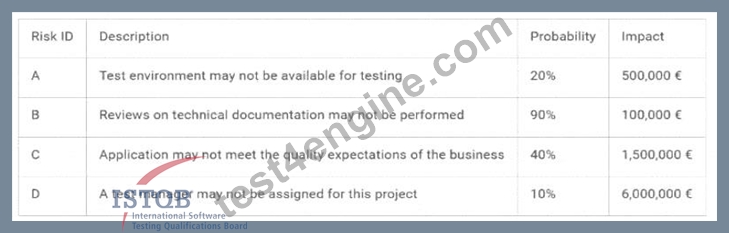
Which risk should the System Testing focus on mitigating first?
SELECT ONE OPTION
- A. Risk B.
- B. Risk C
- C. Risk A.
- D. Risk D
Answer: B
NEW QUESTION # 110
Explain how the above mentioned report may differ from a report that you produce for the project manager, who is a test specialist Select TWO items from the following options that can be used to report to the project manager and would not be included in a report to senior management. 1 credit
- A. State recommendations for release
- B. Show details on effort spent
- C. List of all outstanding defects with their priority and severity
- D. Give product risk status
- E. Show trend analysis
Answer: B,C
Explanation:
Explanation/Reference:
Explanation:
NEW QUESTION # 111
Part of the testing strategy indicates that you are going to be using systematic test design techniques. Your manager has asked that you present the main advantages of using these techniques at the next board meeting. Identify THREE main benefits of using systematic test design techniques within this company. 2 credits (for 2 out of 3 correct 1 credit)
- A. Easier to quickly adapt testing to changing requirements compared to experienced-based testing
- B. Provides a way to differentiate depth of testing based on product risks by using different techniques
- C. Will guide experienced testers to find defects
- D. Targets certain types of faults
- E. Will make non-systematic testing redundant
- F. More enhanced documentation and therefore higher repeatability and reproducibility
- G. Will reduce the need for early reviews
Answer: B,D,F
Explanation:
Explanation/Reference:
Explanation:
NEW QUESTION # 112
Your project manager has requested that you run management reviews in her absence. Which two of the following might you be expected to do at these reviews?
a. Check for defects in requirements documents.
b. Check the process to see if it passes the assessment.
c. Check the consistency of the project plan.
d. Check compliance by conducting evidential interviews
e. Check adequacy of management procedures.
f. Check contractual compliance for a software product Select one correct answer from the options below:
- A. a and b.
- B. e and f.
- C. c and d.
- D. c and e.
Answer: D
NEW QUESTION # 113
You are a new lest manager in an organization You have been asked to assess the defect process to determine if there are any efficiency improvements that could be made that would reduce the cost of quality You have started digging through the defect Information What information would be most helpful for this investigation?
- A. The phase in which a defect was introduced versus the phase in which it was found
- B. Areas of the software producing the most defects
- C. Defect priorities and seventies as related to time from reporting to closure
- D. Risk areas m which defects have been detected and the
- E. relationship between the risk rating of the software and the seventy of the defect
Answer: E
Explanation:
* Key Data for Defect Process Improvement:
* Analyzing when defects are introduced versus when they are detected is critical to identifying process inefficiencies.
* This information helps pinpoint gaps in earlier phases, allowing the team to implement preventive measures and reduce overall costs.
* Evaluation of Options:
* AandBare useful but do not address the root cause of inefficiencies.
* C(Risk areas and severity relationship) is helpful but secondary to understanding phase discrepancies.
* Dis correct as it provides the most actionable insights for process improvement.
References and Syllabus Alignment:
* Defect lifecycle analysis is discussed under "Defect Management" (TM-2.3.1) in the ISTQB syllabus.
NEW QUESTION # 114
Which of the following software characteristics are possibly revealed through the application of a open source static analysis tool? [1]
- A. Timing dependencies
- B. Coding standard violations
- C. Memory leaks
- D. Concurrency thresholds
Answer: B
Explanation:
A static analysis tool is a software tool that analyzes the source code of a program without executing it. It can detect various software characteristics, such as syntax errors, potential bugs, security vulnerabilities, code quality, and coding standard violations. Coding standard violations are deviations from the agreed or recommended rules and conventions for writing source code, such as naming, indentation, formatting, commenting, and complexity. A static analysis tool can check the source code against a predefined or customized coding standard and report any violations. Coding standard violations can affect the readability, maintainability, and portability of the code, and can also introduce defects or inconsistencies. List of tools for static code analysisTop 5 Open Source Source and Free Static Code Analysis Tools in 2020 Reference:
List of tools for static code analysis - Wikipedia
Top 5 Open Source Source and Free Static Code Analysis Tools in 2020 - GeeksforGeeks
NEW QUESTION # 115
Your company specialises in the manufacture of luxury garden furniture to the UK market and it is starting a project that will deliver a major update to its payment processing component, addressing improvements to functional suitability and performance efficiency.
A decision has been made to transfer responsibility for functional system test procedure creation and execution to a software house, located offshore. System test analysis and design will be performed onshore, at the company's UK headquarters. As the senior test manager for your company, you want to employ another experienced test manager to oversee the daily operations of the software house to ensure that their work meets required quality standards and adheres to the agreed organisational test strategy and project test plan.
Which option presents the skills that are of MOST relevance for the new test manager role?
- A. Professional competence - knowledge of performance test design and execution. Social competence - awareness of cultural differences and challenges.
- B. Professional competence - ability to develop a test strategy. Social competence - ability to develop the skills of the third-party testers.
- C. Professional competence - knowledge of test implementation and execution. Methodological competence - application of black- and white-box test techniques.
- D. Professional competence - project management skills. Social competence - communication, conflict resolution and assertiveness.
Answer: B
Explanation:
For a test manager overseeing an offshore team, having theprofessional competence to define a test strategy ensures the alignment with organizational goals and standards. Thesocial competence to develop skills of third-party testersis equally critical for quality assurance in outsourced environments. This includes mentoring, aligning objectives, and enabling continuous improvement of remote teams. These are explicitly discussed in ISTQB Advanced Test Manager responsibilities.
NEW QUESTION # 116
A car rental company offers discounts to its customers based on a number of factors, including booking history, length of membership and type of car being booked. An update to the rental application is under test, with test cases written that specifically address a documented product risk covering discount calculation.
Although the risk impact was analysed as high, the likelihood was given as low, as there had been no known changes to the calculation rules. However, during test execution some discount calculations were incorrect and investigation showed that code changes had been made that impacted the discount algorithms. As a result, the likelihood was increased to high by the risk management team.
Which would be the BEST measure to take to respond to the current situation?
- A. Review the composition of the risk management team to ensure a better diversity of stakeholders
- B. Monitor the risk and adjust the risk register to reflect the changed risk level and any new risksdiscovered
- C. Update the test case coverage of the discount calculation risk to reflect the increased risk level
- D. Adopt a risk-based testing strategy to help mitigate failures in the rental application
Answer: C
Explanation:
When the likelihood or impact of a risk changes, the response should include adapting the testing effort accordingly. Since the risk level has increased,the coverage of the risk through test cases should be increased as well. This aligns with the principle of risk-based testing that uses updated risk levels to prioritize and adjust test planning and execution:
"Risk-based testing... involves product risk analysis which includes the identification of product risks and the assessment of each risk's likelihood and impact... The resulting product risk information is used to guide test planning, specification, preparation and execution of test cases".
NEW QUESTION # 117
Which of the following is likely to occur if reviewers do not have an adequate level of technical knowledge?
[1]
- A. The review will be shorter because any technical aspect can be skipped.
- B. There will be no impact as long as they have sufficient business knowledge.
- C. There will be no impact as long as they have sufficient process knowledge.
- D. The review is likely to be less efficient.
Answer: D
Explanation:
If reviewers do not have an adequate level of technical knowledge, they may not be able to identify and describe anomalies in the product or project under review1. They may also not be able to provide constructive feedback or suggestions for improvement2. This can result in a less efficient review, as the review objectives may not be met, the review process may take longer, or the review outcome may be of lower quality3.
Therefore, option C is the correct answer. Option A is incorrect because having sufficient business knowledge is not enough to perform a technical review, as business knowledge does not cover the technical aspects of the product or project4. Option B is incorrect because having sufficient process knowledge is not enough to perform a technical review, as process knowledge does not cover the technical aspects of the product or project4. Option D is incorrect because skipping any technical aspect can compromise the quality and completeness of the review, and may lead to defects or risks in the product or project5. References: 1: ISTQB Glossary, Reviewer 2: ISTQB Advanced Level Test Manager Syllabus, Section 2.2.2 3: ISTQBAdvanced Level Test Manager Syllabus, Section 2.2.3 4: ISTQB Advanced Level Test Manager Syllabus, Section
2.3.1 5: ISTQB Advanced Level Test Manager Syllabus, Section 2.3.2
NEW QUESTION # 118
Which of the following defect statistics will provide input to be used for improvement in the defect reporting process?
- A. Number of defects found in a phase later than they were introduced
- B. Number of defect reports rejected by the developers
- C. Number of defect reports re-opened
- D. Number of defects in a particular area of the code
Answer: B
Explanation:
Purpose of the Questio n :
Identifying metrics to improve the defect reporting process by reducing ambiguities or improving accuracy.
Evaluation of Options:
A . Number of defect reports re-opened:
Incorrect. This reflects issues with defect resolution rather than reporting.
B . Number of defects in a particular area of the code:
Incorrect. This metric pertains to defect clustering, not the reporting process.
C . Number of defect reports rejected by the developers:
Correct. Rejected reports often indicate poor reporting quality (e.g., insufficient details, incorrect categorization), directly highlighting areas for improvement.
D . Number of defects found in a phase later than they were introduced:
Incorrect. This is a measure of defect detection efficiency, not reporting quality.
Syllabus Alignment:
The syllabus stresses the importance of using defect metrics to refine processes, including reporting accuracy (TM-2.3.5).
Reference:
ISTQB Advanced Level Test Management Syllabus (TM-2.3.5)
NEW QUESTION # 119
Club 65 to 90 is a holiday club for retired people run by a small company, the IT department consists of 1 Designer, 3 Developers and 1 System Tester Their booking system has been "live" for a number of years and the company has a loyal client base. A variety of automation tools are used for development and testing to improve effectiveness and efficiency.
A new project will introduce a loyalty scheme and both a Business Requirement Specification and a System Design Specification have been produced A Rapid Application Development (RAD) lifecycle model will be used where time is crucial. In the past there have been problems with updates to the existing system, which has affected existing functionality. Testers have not used representative and realistic operational profiles and data, which has led to significant production problems. The following test policy statements have been proposed for the project:
a. Testing must be risk based;
b. A Master Test Plan, confirming to IEEE829, must be produced for each test project; c. Test procedures must be run by a tester who did not write the procedure; d. Regression testing should be carried out on all releases; e. The testers are accountable for all defects found in production; f. Time must be given to designing test environments so that they are representative of the live environment. Which of the following options identifies the three policy statements that would be MOST beneficial for this project?
- A. a. b and e.
- B. a, d and e.
- C. b. c and f.
- D. a. d and f.
Answer: D
NEW QUESTION # 120
Your last project was released three months ago and used a risk-based approach. In production, a number of serious failures in low risk areas have occurred.
What is the most important lesson to be learned from this information? [2]
- A. The "lessons learned" session should have been conducted prior to deployment.
- B. A broader cross-functional team should contribute to the risk analysis.
- C. The project manager should have set stakeholder expectations for serious failures.
- D. Future projects should test the lower risk areas first.
Answer: B
Explanation:
The most important lesson to be learned from this information is that a broader cross-functional team should contribute to the risk analysis. This is because the risk analysis is the process of identifying, assessing, and prioritizing the risks that may affect the quality of the system, and allocating testing resources accordingly. A broader cross-functional team can provide different perspectives, expertise, and experience to the risk analysis, and help to identify and evaluate the risks more accurately and comprehensively. This can reduce the likelihood of overlooking or underestimating some risks, and improve the effectiveness and efficiency of the risk-based testing approach. Risk Analysis - ISTQB not-for-profit association References: Certified Tester Advanced Level Test Manager (CTAL-TM) - ISTQB not-for-profit association, ISTQB Test Manager Certification - ISTQB Exams Worldwide - ISTQB Official Registration, Risk Analysis - ISTQB not-for-profit association
NEW QUESTION # 121
Given is the following defect removal chart reported at the end of system testing - showing total defects detected and closed defects (fixed and successfully retested). A number of open defects are classified as critical. All tests have been executed.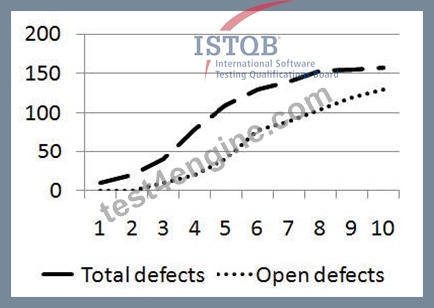
Based on the chart above, what is the most appropriate next test phase? 1 credit
- A. Acceptance testing to verify operational requirements
- B. Another system test cycle to verify defect resolution
- C. Acceptance testing to verify the business process
- D. Requirements testing as part of testing regulatory compliance
Answer: B
NEW QUESTION # 122
SCENARIO 1
DreamPartner dating agency are redesigning their dating application following a major security breach in which sensitive customer data was made publically available. The redesign includes stronger security encryption and performance tuning.
The product risk register for the redesign project, which was produced after all requirements had been agreed, includes the following: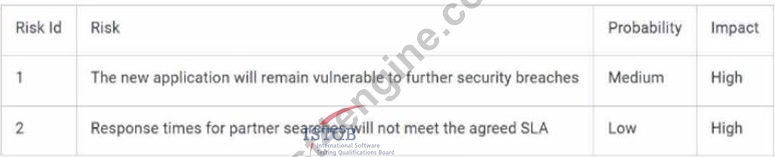
The organisational Test Strategy contains the following objectives:
1. A Risk-based lest approach must be adopted for all projects
2. Functional regression testing should start as soon as functional testing is complete
3. Automated tests may be run before or in parallel with manual tests
The project Test Plan has allocated 6 weeks to complete all test execution, with functional testing taking 3 weeks to execute, performance and security testing 2 weeks each and regression testing 1 week.
Which of the following options places the test suites (TS1 to TS5) in the correct order for test execution?
SELECT ONE OPTION
- A. TS1, TS2, TS5, TS3, TS4.
- B. TS5, TR1, TS3 TSA, TS2
- C. TS3, TS1, TS2, TS5, TS4.
- D. TS3, TS4, TS1, TS2, TS5.
Answer: C
NEW QUESTION # 123
Which of the following is a valid drawback of independent testing? 1 credit
- A. Independent testers will become a bottleneck and introduce problems in incident management.
- B. Independent testers need extra education and always cost more.
- C. Developers loose the sense of responsibility and independent testers may become a bottleneck.
- D. Developer and independent testing will overlap and waste resources.
Answer: C
Explanation:
Explanation/Reference:
Explanation:
NEW QUESTION # 124
You are about to release a test progress report to a senior manager, who is not a test specialist. Which of the following topics should NOT be included in the test progress report? 1 credit
- A. Status compared against the started exit criteria
- B. Product risks which have been mitigated and those which are outstanding.
- C. Detailed overview of the risk-based test approach being used to ensure the exit criteria to be achieved
- D. Recommendations for taking controlling actions
Answer: C
NEW QUESTION # 125
You are Test Manager for a project which is in the Test Implementation stage for the first planned iteration, creation of the initial Test Cases and required test data is progressing well.
The Test Strategy documents the Stakeholders view that small teams should collaborate together to create and test functionality which is to be released in iterations, with each release building on the success of the last.
Stakeholders are willing to accept the risks of a partly working system in the early stages. Delivery of working functionality (particularly around interfaces to third party systems and performance of back end databases) is the priority for the early releases.
Which of the following test types would you select for this first planned iteration, in order to meet Stakeholders expectations?
a) Usability testing
b) Structural testing
c) Functional testing of process flows
d) Performance testing
e) Business process testing
f) Component integration testing
- A. a, c, d and e.
- B. b, c, d and f.
- C. a. b, d and f.
- D. b, d, e and f.
Answer: A
NEW QUESTION # 126
You have done a comprehensive risk analysis. You have involved the appropriate people in assessing the risks and determining the likelihood and impact of those risks. You have been testing for three months and have been able to mitigate 75% of the high risk items. You have two weeks left in testing and you now do not expect to be able to complete all the items on the high-risk mitigation list, never mind any from the medium or low-risk lists.
What is the most effective action you should take? [3]
- A. Use a random selection algorithm to pick tests from the high, medium, and low risk mitigation lists - thereby ensuring that each risk list has some mitigation.
- B. Retest the highest risk areas to ensure no regressions have occurred.
- C. Present your risk mitigation progress and project status to the project's stakeholders, and request additional time or assistance in re-prioritizing the remaining high-risk items.
- D. Concentrate testing in areas that have already found numerous problems.
Answer: C
Explanation:
When faced with the inability to complete all items on the high-risk mitigation list within the remaining time, the most effective action is to communicate the current progress and challenges to the stakeholders. This allows for a collaborative decision-making process to re-prioritize the remaining high-risk items and potentially secure additional resources or time to address them.
Reference:
The ISTQB Advanced Level Test Manager syllabus emphasizes the importance of continuous monitoring and control of test activities to achieve project objectives, which includes assessing and reporting relevant and timely test status to project stakeholders123. It also highlights the need for test managers to organize and lead risk identification and analysis sessions, and use the results for test planning, monitoring, and control2.
NEW QUESTION # 127
Which aspect in the test estimate is the main risk in this project? 1 credit
- A. Unknown input quality due to third party development
- B. Quality of the specification
- C. Availability of end-users
- D. The costs of hardware and tools
Answer: A
Explanation:
Topic 8, Scenario 8, V2 "Test Proems Improvement'
You have raised the issue that improving the testing process is also dependent on the status of the software development process.
NEW QUESTION # 128
Which of the Mowing Is commonly used by a test manager to identity risks'
- A. Function points within the software
- B. Record/playback test automation tools
- C. Lines of code in the system under test
- D. Experience with similar projects
Answer: D
Explanation:
* Common Risk Identification Techniques:
* A test manager often relies on experience with similar projects to foresee risks related to technical complexity, domain challenges, or previous defects.
* Other options listed are less effective for comprehensive risk identification.
* Evaluation of Options:
* A(Lines of code) andB(Function points) are quantitative measures, not directly tied to risk identification.
* Cis correct as past experience is crucial for identifying risks early.
* D(Record/playback tools) is irrelevant to risk analysis.
References and Syllabus Alignment:
* Risk identification techniques are discussed under "Risk Management" (TM-1.3.1).
NEW QUESTION # 129
......
CTAL-TM-001 Dumps and Practice Test (232 Exam Questions): https://troytec.test4engine.com/CTAL-TM-001-real-exam-questions.html