


Free AI-900 Braindumps Download Updated on Dec 08, 2025 with 325 Questions
Microsoft AI-900 Exam Practice Test Questions
NEW QUESTION # 165
Match the Al solution to the appropriate task.
To answer, drag the appropriate solution from the column on the left to its task on the right. Each solution may be used once, more than once, or not at all.
NOTE: Each correct match is worth one point.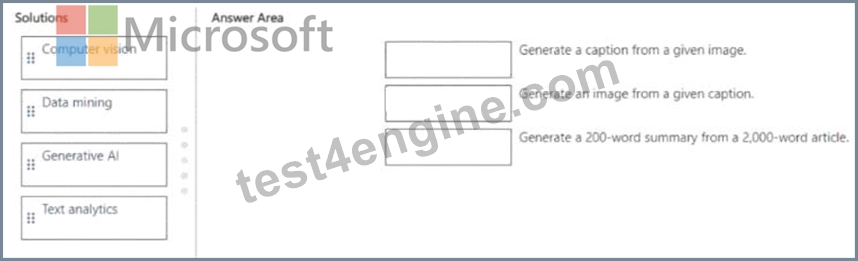
Answer:
Explanation: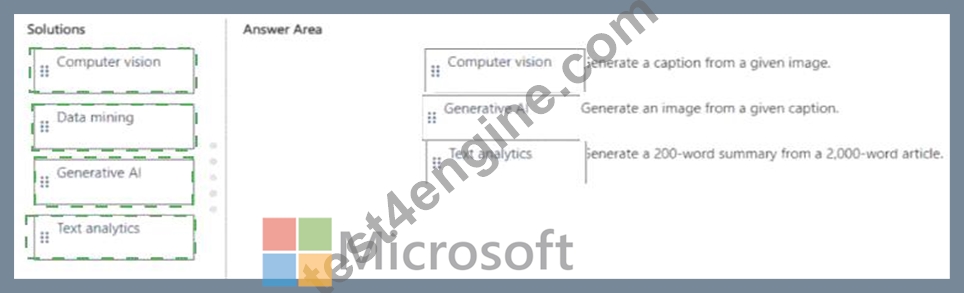
Explanation: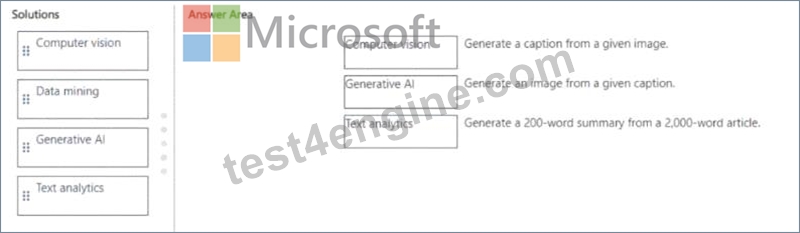
NEW QUESTION # 166
Match the types of AI workloads to the appropriate scenarios.
To answer, drag the appropriate workload type from the column on the left to its scenario on the right. Each workload type may be used once, more than once, or not at all.
NOTE: Each correct selection is worth one point.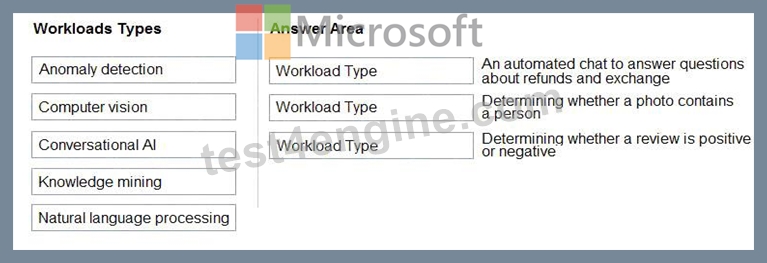
Answer:
Explanation: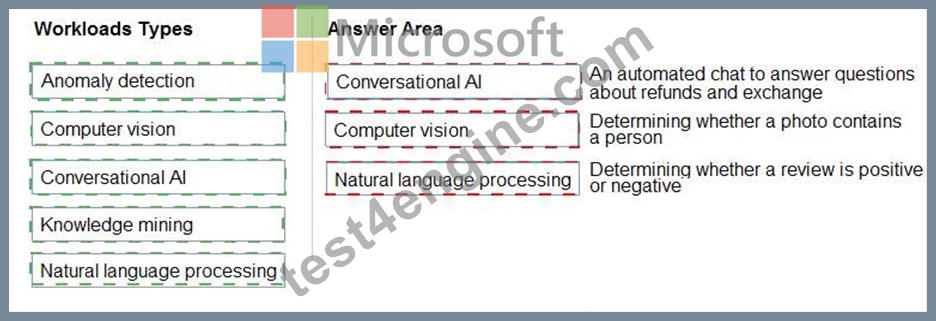
Explanation: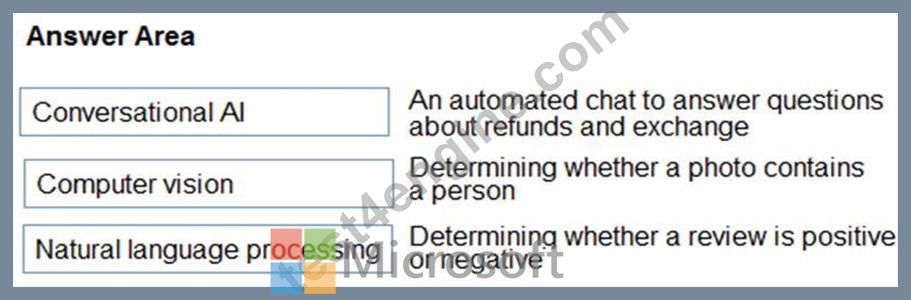
Box 3: Natural language processing
Natural language processing (NLP) is used for tasks such as sentiment analysis, topic detection, language detection, key phrase extraction, and document categorization.
Reference:
https://docs.microsoft.com/en-us/azure/architecture/data-guide/technology-choices/natural-language- processing
NEW QUESTION # 167
You need to create a clustering model and evaluate the model by using Azure Machine Learning designer.
What should you do?
- A. Split the original dataset into a dataset for training and a dataset for testing. Use the testing dataset for evaluation.
- B. Use the original dataset for training and evaluation.
- C. Split the original dataset into a dataset for features and a dataset for labels. Use the features dataset for evaluation.
- D. Split the original dataset into a dataset for training and a dataset for testing. Use the training dataset for evaluation.
Answer: A
NEW QUESTION # 168
To complete the sentence, select the appropriate option in the answer area.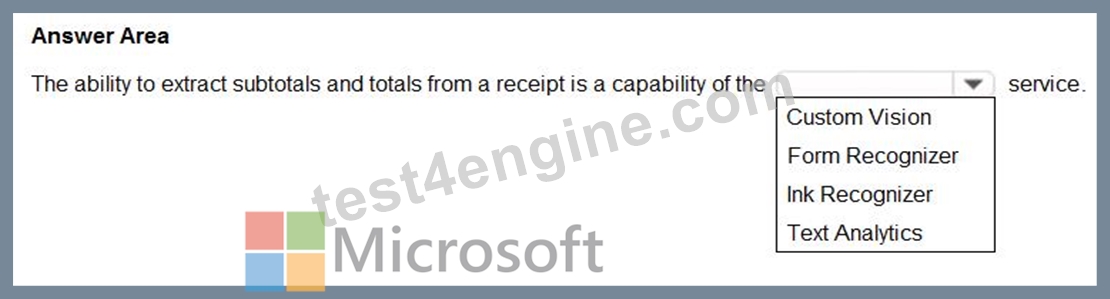
Answer:
Explanation: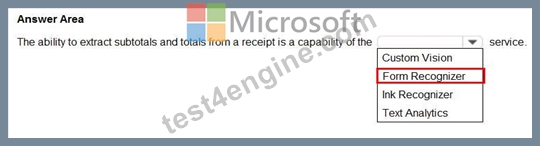
Reference:
https://azure.microsoft.com/en-us/services/cognitive-services/form-recognizer/
NEW QUESTION # 169
You need to build an app that will read recipe instructions aloud to support users who have reduced vision.
Which version service should you use?
- A. Speech
- B. Translator Text
- C. Text Analytics
- D. Language Understanding (LUIS)
Answer: A
Explanation:
Section: Describe features of Natural Language Processing (NLP) workloads on Azure Explanation/Reference:
https://azure.microsoft.com/en-us/services/cognitive-services/text-to-speech/#features
NEW QUESTION # 170
For each of the following statements, select Yes if the statement is true. Otherwise, select No.
NOTE: Each correct selection is worth one point.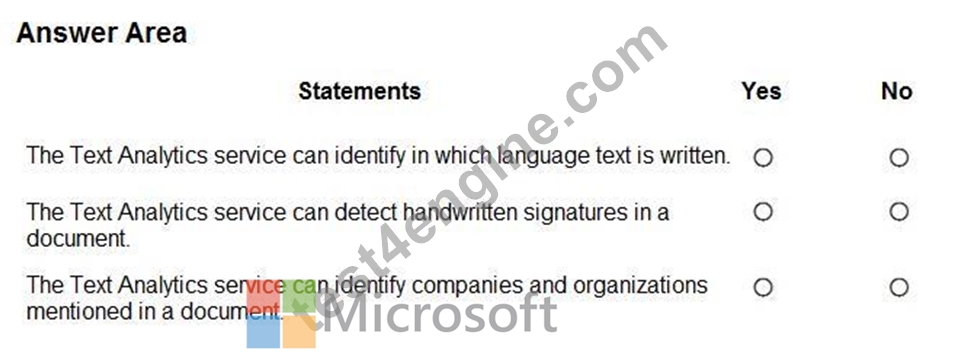
Answer:
Explanation:
Explanation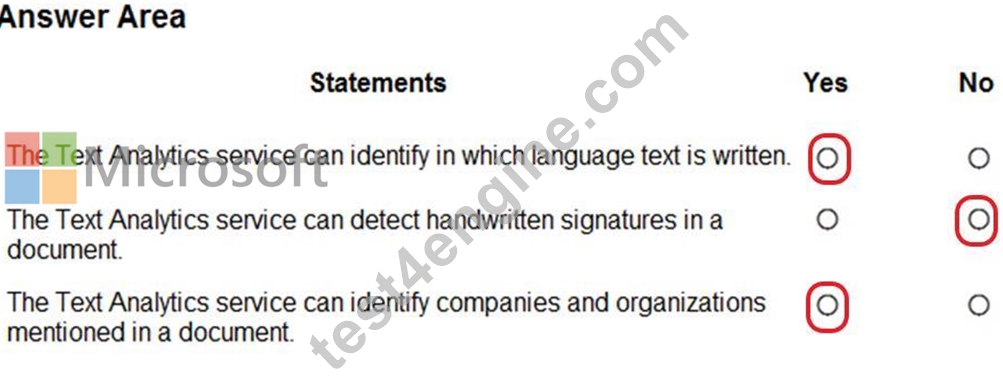
The Text Analytics API is a cloud-based service that provides advanced natural language processing over raw text, and includes four main functions: sentiment analysis, key phrase extraction, named entity recognition, and language detection.
Box 1: Yes
You can detect which language the input text is written in and report a single language code for every document submitted on the request in a wide range of languages, variants, dialects, and some regional/cultural languages. The language code is paired with a score indicating the strength of the score.
Box 2: No
Box 3: Yes
Named Entity Recognition: Identify and categorize entities in your text as people, places, organizations, date/time, quantities, percentages, currencies, and more. Well-known entities are also recognized and linked to more information on the web.
Reference:
https://docs.microsoft.com/en-us/azure/cognitive-services/text-analytics/overview
NEW QUESTION # 171
For each of the following statements, select Yes if the statement is true. Otherwise, select No.
NOTE: Each correct selection is worth one point.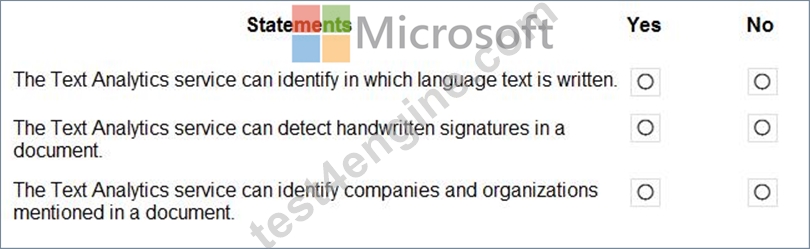
Answer:
Explanation: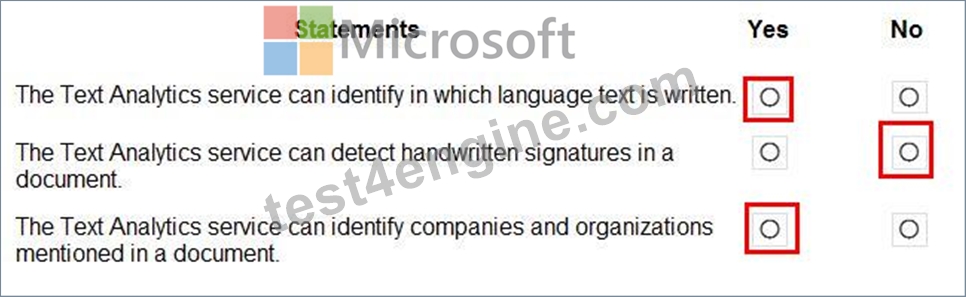
Explanation:
The Text Analytics API is a cloud-based service that provides advanced natural language processing over raw text, and includes four main functions: sentiment analysis, key phrase extraction, named entity recognition, and language detection.
Box 1: Yes
You can detect which language the input text is written in and report a single language code for every document submitted on the request in a wide range of languages, variants, dialects, and some regional/cultural languages. The language code is paired with a score indicating the strength of the score.
Box 2: No
Box 3: Yes
Named Entity Recognition: Identify and categorize entities in your text as people, places, organizations, date/time, quantities, percentages, currencies, and more. Well-known entities are also recognized and linked to more information on the web.
Reference:
https://docs.microsoft.com/en-us/azure/cognitive-services/text-analytics/overview
NEW QUESTION # 172
Select the answer that correctly completes the sentence.
Answer:
Explanation:
NEW QUESTION # 173
For each of the following statements, select Yes if the statement is true. Otherwise, select No.
NOTE: Each correct selection is worth one point.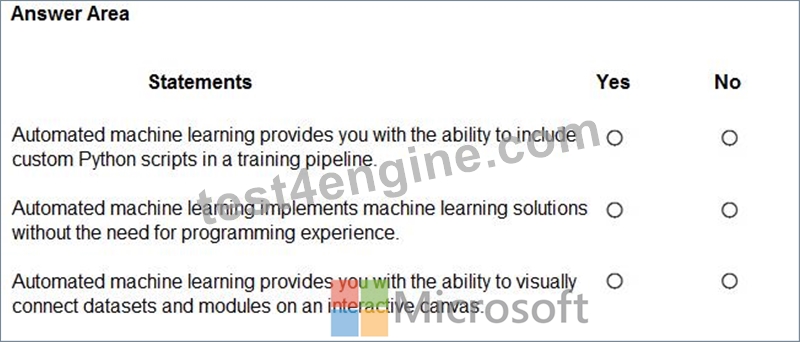
Answer:
Explanation: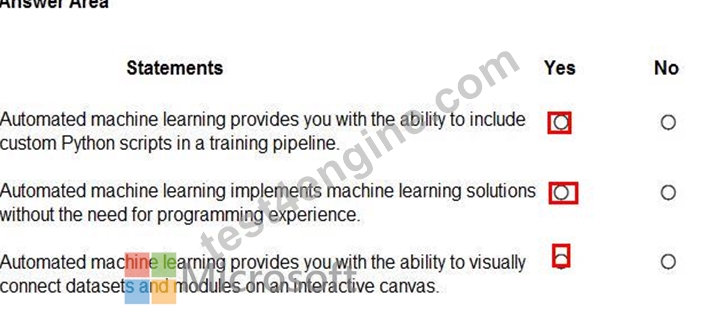
Reference:
https://docs.microsoft.com/en-us/azure/machine-learning/how-to-designer-python
https://docs.microsoft.com/en-us/azure/machine-learning/concept-automated-ml
NEW QUESTION # 174
Select the answer that correctly completes the sentence.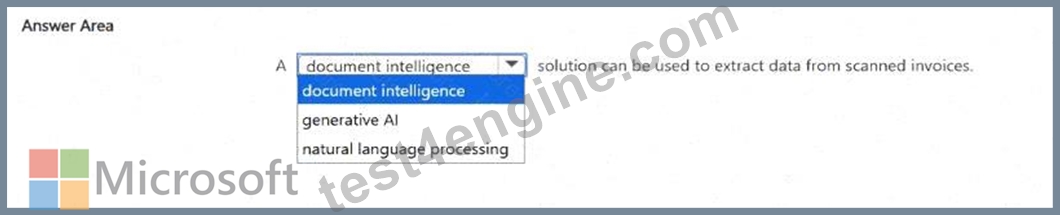
Answer:
Explanation: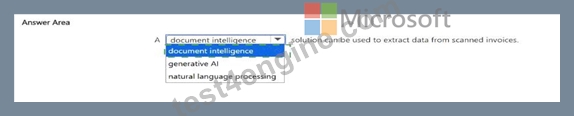
Explanation:
The correct answer is Document Intelligence.
According to the Microsoft Azure AI Fundamentals (AI-900) study materials and Microsoft Learn documentation, the Azure AI Document Intelligence service (formerly known as Form Recognizer) is specifically designed to extract structured data from documents, including scanned invoices, receipts, forms, and business cards.
This service combines optical character recognition (OCR) with machine learning to analyze both the layout and semantic meaning of document content. When processing scanned invoices, Document Intelligence identifies and extracts fields such as invoice numbers, dates, totals, taxes, vendor names, and line-item details.
The extracted information can then be automatically imported into business systems like accounting software or databases, eliminating manual data entry and improving operational efficiency.
Here's why the other options are incorrect:
* Generative AI: Focuses on creating new content such as text, images, or code (for example, using GPT-
4 or DALL E). It is not used for structured data extraction.
* Natural Language Processing (NLP): Deals with understanding and generating human language from text-based input, not document scanning or layout interpretation.
The Document Intelligence workload excels at handling semi-structured documents where the location and format of data vary between samples. Microsoft's prebuilt models-like Invoice, Receipt, Identity Document, and Contract-simplify extraction without requiring custom training.
In summary, if the task involves extracting data from scanned invoices, the appropriate Azure AI service is Azure AI Document Intelligence, which uses AI-powered document understanding to convert unstructured document images into structured, usable data.
NEW QUESTION # 175
brectly completes the sentence.
Answer:
Explanation:
Explanation:
According to the Microsoft Azure AI Fundamentals (AI-900) official study guide and the Microsoft Learn module "Identify features of common AI workloads", OCR (Optical Character Recognition) is a Computer Vision technology that detects and extracts printed or handwritten text from images and scanned documents.
OCR allows organizations and individuals to convert physical or image-based text into machine-readable, editable, and searchable digital text.
In the context of this question, a historian working with old newspaper articles or archival documents would use OCR to digitize printed content. For instance, the historian can scan or photograph old newspaper pages, and then use an OCR tool-such as Azure Computer Vision's OCR API-to automatically recognize and extract the textual content from those images. This process enables the historian to store, edit, and analyze the content digitally without manually typing everything.
OCR works by using deep learning algorithms trained on thousands of text samples. The system analyzes patterns, shapes, and spatial relationships of characters to identify text accurately, even from low-quality or aged paper documents. Once extracted, the digital text can be indexed, translated, or processed further using Natural Language Processing (NLP) tools for content analysis.
Now, addressing the other options:
* Facial analysis is used to detect emotions, age, or gender from human faces-irrelevant to text digitization.
* Image classification identifies entire images by categories (e.g., cat, car, flower).
* Object detection identifies and locates multiple objects within an image but doesn't extract text.
Therefore, per the AI-900 learning objectives under the Computer Vision workload, the correct and verified completion is:
NEW QUESTION # 176
For each of the following statements, select Yes if the statement is true. Otherwise, select No.
NOTE: Each correct selection is worth one point.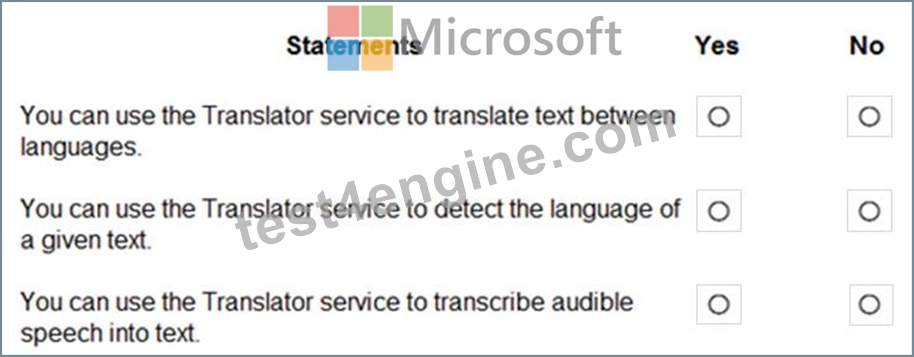
Answer:
Explanation: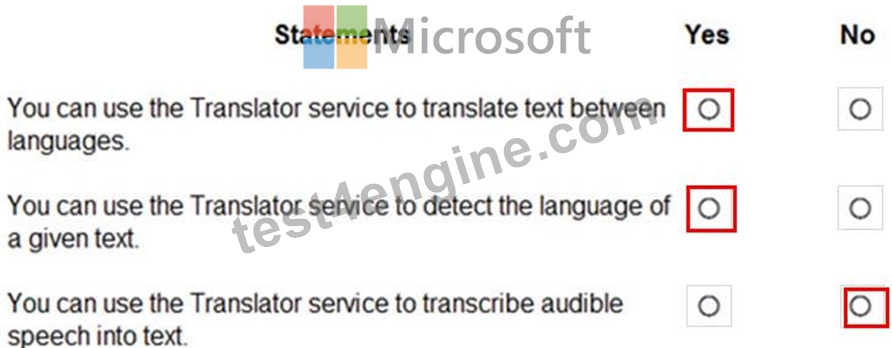
Reference:
https://docs.microsoft.com/en-us/azure/cognitive-services/Translator/translator-info-overview
https://docs.microsoft.com/en-us/legal/cognitive-services/speech-service/speech-to-text/transparency-note
NEW QUESTION # 177
You need to scan the news for articles about your customers and alert employees when there is a negative article. Positive articles must be added to a press book.
Which natural language processing tasks should you use to complete the process? To answer, drag the appropriate tasks to the correct locations. Each task may be used once, more than once, or not at all. You may need to drag the split bar between panes or scroll to view content.
NOTE: Each correct selection is worth one point.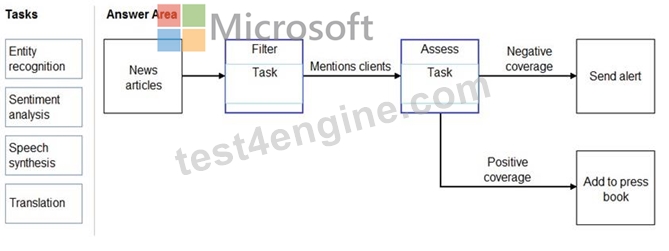
Answer:
Explanation: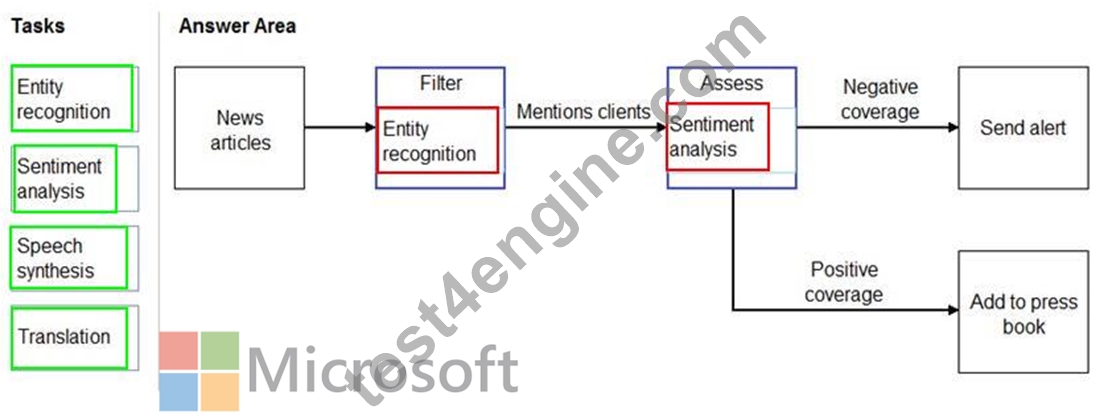
Reference:
https://docs.microsoft.com/en-us/azure/machine-learning/studio-module-reference/named-entity-recognition
https://docs.microsoft.com/en-us/azure/cognitive-services/text-analytics/how-tos/text-analytics-how-to-sentiment-analysis
NEW QUESTION # 178
Select the answer that correctly completes the sentence.
Answer:
Explanation:
NEW QUESTION # 179
For each of the following statements, select Yes if the statement is true. Otherwise, select No.
NOTE: Each correct selection is worth one point.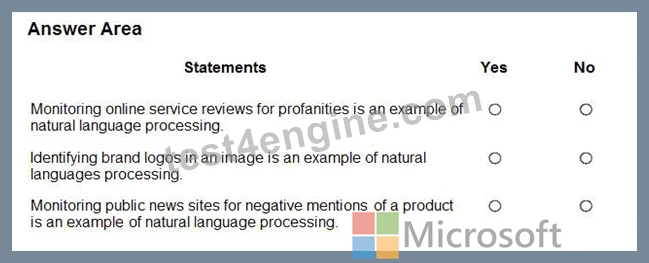
Answer:
Explanation: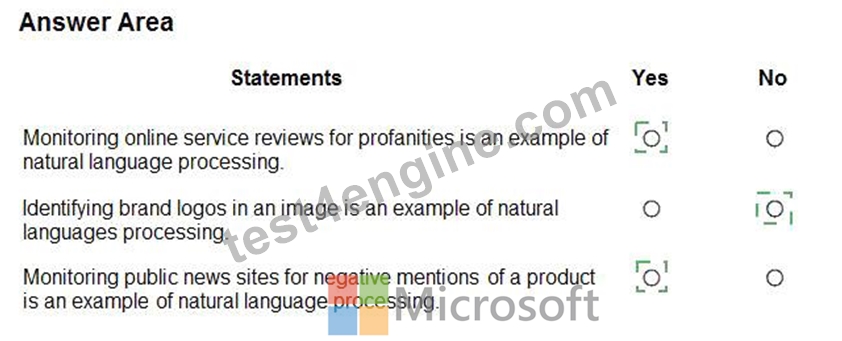
Explanation: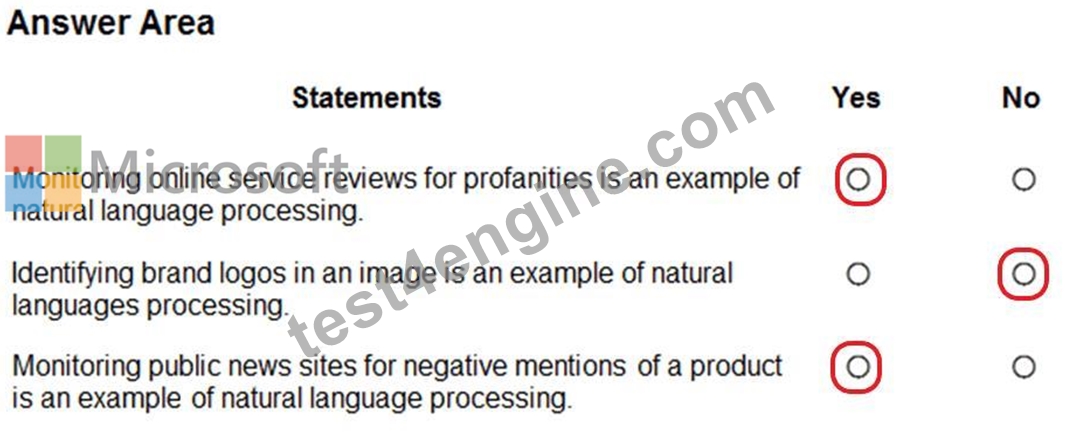
This question examines your understanding of Natural Language Processing (NLP) as described in the Microsoft Azure AI Fundamentals (AI-900) official study guide and Microsoft Learn module "Explore natural language processing." NLP is a branch of artificial intelligence that enables computers to analyze, understand, and generate human language - both written and spoken. Typical NLP tasks include text analytics, language understanding, sentiment analysis, key phrase extraction, and profanity detection.
* Monitoring online service reviews for profanities # YesThis is a classic example of NLP. Detecting profane or inappropriate words in customer reviews requires analyzing text content. Azure Cognitive Services offers Content Moderator and Text Analytics APIs that can detect and filter profanity, sentiment, and offensive language automatically. Microsoft Learn states: "Natural language processing is used to process and analyze text to detect sentiment, key phrases, and inappropriate content." Hence, this task is correctly classified as NLP.
* Identifying brand logos in an image # NoThis task belongs to Computer Vision, not NLP. The Computer Vision API and Custom Vision service in Azure are designed to detect and classify visual elements like logos, objects, or scenes. Since it involves images, not text, it is unrelated to natural language processing.
* Monitoring public news sites for negative mentions of a product # YesThis is another valid example of NLP. The process involves analyzing the sentiment of text from online articles to determine whether mentions of a product are positive, neutral, or negative. Azure Text Analytics provides prebuilt sentiment analysis and entity recognition capabilities that help automate such monitoring.
NEW QUESTION # 180
For each of the following statements, select Yes if the statement is true. Otherwise, select No. NOTE: Each correct selection is worth one point.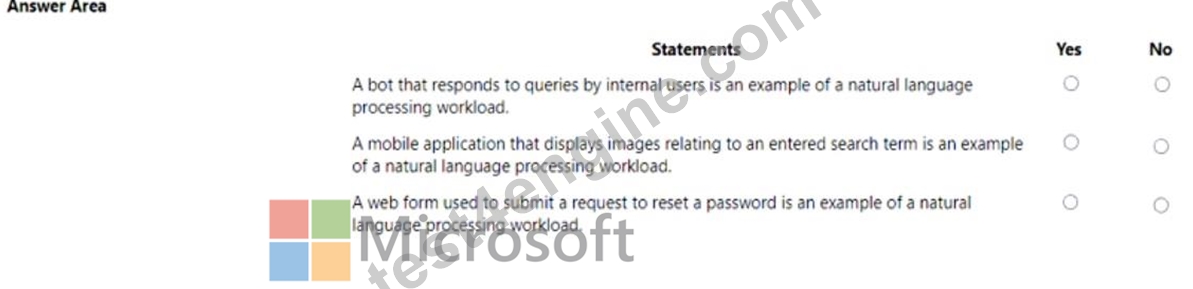
Answer:
Explanation: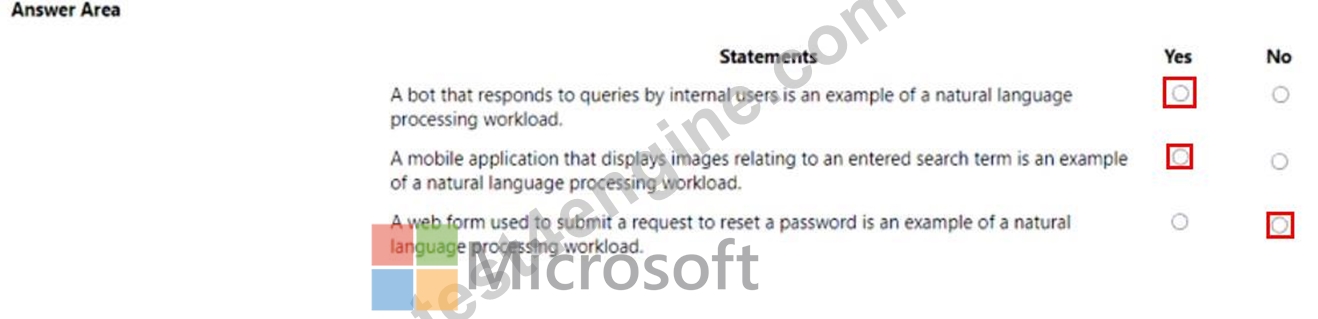
NEW QUESTION # 181
To complete the sentence, select the appropriate option in the answer area.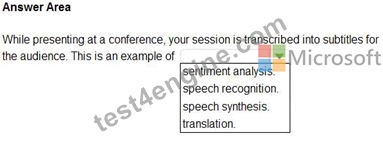
Answer:
Explanation: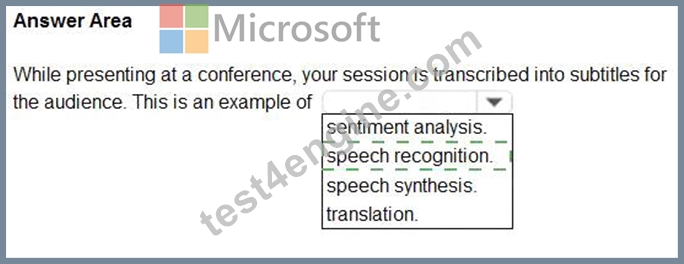
Explanation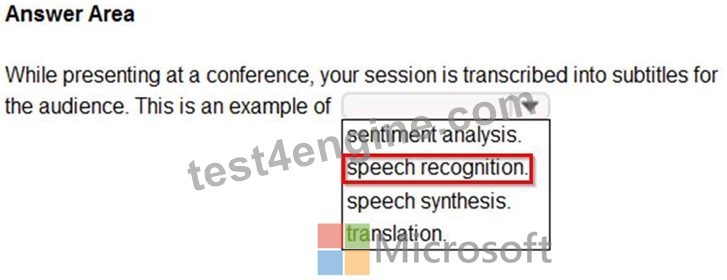
Reference:
https://azure.microsoft.com/en-gb/services/cognitive-services/speech-to-text/#features Speech recognition means Speech to Text. In the above example as a person speaks the words are converted into text of the same language. Hence Speech to Text also called Speech recognition is the right answer.
Speech recognition - the ability to detect and interpret spoken input.
Speech synthesis - the ability to generate spoken output.
https://docs.microsoft.com/en-us/learn/modules/recognize-synthesize-speech/1-introduction
NEW QUESTION # 182
For each of the following statements, select Yes if the statement is true. Otherwise, select No.
NOTE: Each correct selection is worth one point.
Answer:
Explanation: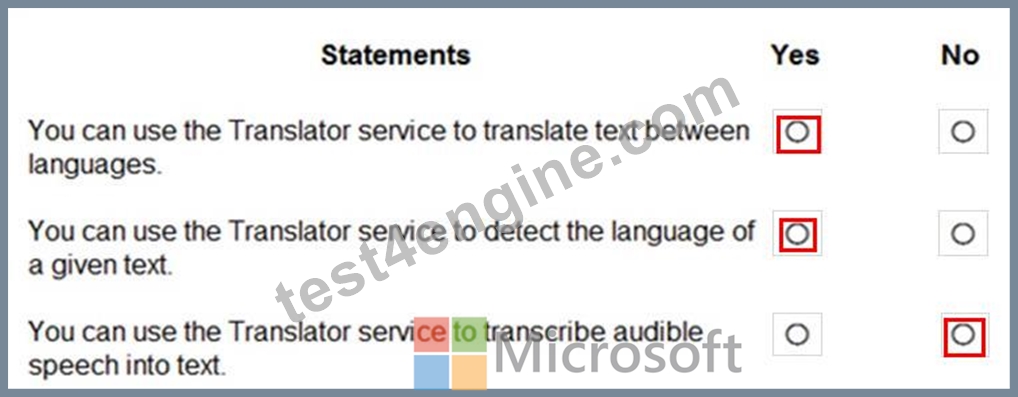
Reference:
https://docs.microsoft.com/en-us/azure/cognitive-services/Translator/translator-info-overview
https://docs.microsoft.com/en-us/legal/cognitive-services/speech-service/speech-to-text/transparency-note
NEW QUESTION # 183
Select the answer that correctly completes the sentence.
Answer:
Explanation:
NEW QUESTION # 184
......
Updated Verified AI-900 dumps Q&As - Pass Guarantee or Full Refund: https://troytec.test4engine.com/AI-900-real-exam-questions.html