


Best Value Available! 2025 Realistic Verified Free Associate-Developer-Apache-Spark-3.5 Exam Questions
Pass Your Exam Easily! Associate-Developer-Apache-Spark-3.5 Real Question Answers Updated
NEW QUESTION # 33
A developer notices that all the post-shuffle partitions in a dataset are smaller than the value set forspark.sql.
adaptive.maxShuffledHashJoinLocalMapThreshold.
Which type of join will Adaptive Query Execution (AQE) choose in this case?
- A. A Cartesian join
- B. A broadcast nested loop join
- C. A sort-merge join
- D. A shuffled hash join
Answer: D
Explanation:
Comprehensive and Detailed Explanation From Exact Extract:
Adaptive Query Execution (AQE) dynamically selects join strategies based on actual data sizes at runtime. If the size of post-shuffle partitions is below the threshold set by:
spark.sql.adaptive.maxShuffledHashJoinLocalMapThreshold
then Spark prefers to use a shuffled hash join.
From the Spark documentation:
"AQE selects a shuffled hash join when the size of post-shuffle data is small enough to fit within the configured threshold, avoiding more expensive sort-merge joins." Therefore:
A is wrong - Cartesian joins are only used with no join condition.
B is correct - this is the optimized join for small partitioned shuffle data under AQE.
C and D are used under other scenarios but not for this case.
Final Answer: B
NEW QUESTION # 34
An MLOps engineer is building a Pandas UDF that applies a language model that translates English strings into Spanish. The initial code is loading the model on every call to the UDF, which is hurting the performance of the data pipeline.
The initial code is: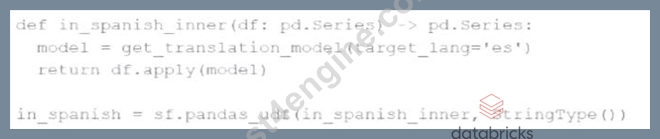
def in_spanish_inner(df: pd.Series) -> pd.Series:
model = get_translation_model(target_lang='es')
return df.apply(model)
in_spanish = sf.pandas_udf(in_spanish_inner, StringType())
How can the MLOps engineer change this code to reduce how many times the language model is loaded?
- A. Convert the Pandas UDF from a Series # Series UDF to a Series # Scalar UDF
- B. Convert the Pandas UDF to a PySpark UDF
- C. Run thein_spanish_inner()function in amapInPandas()function call
- D. Convert the Pandas UDF from a Series # Series UDF to an Iterator[Series] # Iterator[Series] UDF
Answer: D
Explanation:
Comprehensive and Detailed Explanation From Exact Extract:
The provided code defines a Pandas UDF of type Series-to-Series, where a new instance of the language modelis created on each call, which happens per batch. This is inefficient and results in significant overhead due to repeated model initialization.
To reduce the frequency of model loading, the engineer should convert the UDF to an iterator-based Pandas UDF (Iterator[pd.Series] -> Iterator[pd.Series]). This allows the model to be loaded once per executor and reused across multiple batches, rather than once per call.
From the official Databricks documentation:
"Iterator of Series to Iterator of Series UDFs are useful when the UDF initialization is expensive... For example, loading a ML model once per executor rather than once per row/batch."
- Databricks Official Docs: Pandas UDFs
Correct implementation looks like:
python
CopyEdit
@pandas_udf("string")
def translate_udf(batch_iter: Iterator[pd.Series]) -> Iterator[pd.Series]:
model = get_translation_model(target_lang='es')
for batch in batch_iter:
yield batch.apply(model)
This refactor ensures theget_translation_model()is invoked once per executor process, not per batch, significantly improving pipeline performance.
NEW QUESTION # 35
A Spark application suffers from too many small tasks due to excessive partitioning. How can this be fixed without a full shuffle?
Options:
- A. Use the repartition() transformation with a lower number of partitions
- B. Use the sortBy() transformation to reorganize the data
- C. Use the coalesce() transformation with a lower number of partitions
- D. Use the distinct() transformation to combine similar partitions
Answer: C
Explanation:
coalesce(n) reduces the number of partitions without triggering a full shuffle, unlike repartition().
This is ideal when reducing partition count, especially during write operations.
Reference:Spark API - coalesce
NEW QUESTION # 36
A data scientist is working with a Spark DataFrame called customerDF that contains customer information.
The DataFrame has a column named email with customer email addresses. The data scientist needs to split this column into username and domain parts.
Which code snippet splits the email column into username and domain columns?
- A. customerDF.withColumn("username", split(col("email"), "@").getItem(0)) \
.withColumn("domain", split(col("email"), "@").getItem(1)) - B. customerDF.select(
col("email").substr(0, 5).alias("username"),
col("email").substr(-5).alias("domain")
) - C. customerDF.withColumn("username", substring_index(col("email"), "@", 1)) \
.withColumn("domain", substring_index(col("email"), "@", -1)) - D. customerDF.select(
regexp_replace(col("email"), "@", "").alias("username"),
regexp_replace(col("email"), "@", "").alias("domain")
)
Answer: A
Explanation:
Comprehensive and Detailed Explanation From Exact Extract:
Option B is the correct and idiomatic approach in PySpark to split a string column (like email) based on a delimiter such as "@".
The split(col("email"), "@") function returns an array with two elements: username and domain.
getItem(0) retrieves the first part (username).
getItem(1) retrieves the second part (domain).
withColumn() is used to create new columns from the extracted values.
Example from official Databricks Spark documentation on splitting columns:
from pyspark.sql.functions import split, col
df.withColumn("username", split(col("email"), "@").getItem(0)) \
withColumn("domain", split(col("email"), "@").getItem(1))
##Why other options are incorrect:
A uses fixed substring indices (substr(0, 5)), which won't correctly extract usernames and domains of varying lengths.
C uses substring_index, which is available but less idiomatic for splitting emails and is slightly less readable.
D removes "@" from the email entirely, losing the separation between username and domain, and ends up duplicating values in both fields.
Therefore, Option B is the most accurate and reliable solution according to Apache Spark 3.5 best practices.
NEW QUESTION # 37
What is the relationship between jobs, stages, and tasks during execution in Apache Spark?
Options:
- A. A stage contains multiple jobs, and each job contains multiple tasks.
- B. A job contains multiple tasks, and each task contains multiple stages.
- C. A stage contains multiple tasks, and each task contains multiple jobs.
- D. A job contains multiple stages, and each stage contains multiple tasks.
Answer: D
Explanation:
A Sparkjobis triggered by an action (e.g., count, show).
The job is broken intostages, typically one per shuffle boundary.
Eachstageis divided into multipletasks, which are distributed across worker nodes.
Reference:Spark Execution Model
NEW QUESTION # 38
Given the following code snippet inmy_spark_app.py: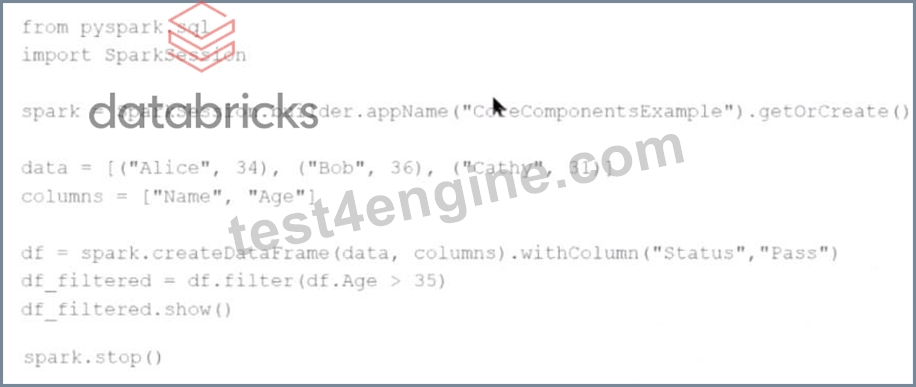
What is the role of the driver node?
- A. The driver node stores the final result after computations are completed by worker nodes
- B. The driver node holds the DataFrame data and performs all computations locally
- C. The driver node only provides the user interface for monitoring the application
- D. The driver node orchestrates the execution by transforming actions into tasks and distributing them to worker nodes
Answer: D
Explanation:
Comprehensive and Detailed Explanation From Exact Extract:
In the Spark architecture, the driver node is responsible for orchestrating the execution of a Spark application.
It converts user-defined transformations and actions into a logical plan, optimizes it into a physical plan, and then splits the plan into tasks that are distributed to the executor nodes.
As per Databricks and Spark documentation:
"The driver node is responsible for maintaining information about the Spark application, responding to a user's program or input, and analyzing, distributing, and scheduling work across the executors." This means:
Option A is correct because the driver schedules and coordinates the job execution.
Option B is incorrect because the driver does more than just UI monitoring.
Option C is incorrect since data and computations are distributed across executor nodes.
Option D is incorrect; results are returned to the driver but not stored long-term by it.
Reference: Databricks Certified Developer Spark 3.5 Documentation # Spark Architecture # Driver vs Executors.
NEW QUESTION # 39
A data engineer observes that an upstream streaming source sends duplicate records, where duplicates share the same key and have at most a 30-minute difference inevent_timestamp. The engineer adds:
dropDuplicatesWithinWatermark("event_timestamp", "30 minutes")
What is the result?
- A. It accepts watermarks in seconds and the code results in an error
- B. It removes all duplicates regardless of when they arrive
- C. It is not able to handle deduplication in this scenario
- D. It removes duplicates that arrive within the 30-minute window specified by the watermark
Answer: D
Explanation:
Comprehensive and Detailed Explanation From Exact Extract:
The methoddropDuplicatesWithinWatermark()in Structured Streaming drops duplicate records based on a specified column and watermark window. The watermark defines the threshold for how late data is considered valid.
From the Spark documentation:
"dropDuplicatesWithinWatermark removes duplicates that occur within the event-time watermark window." In this case, Spark will retain the first occurrence and drop subsequent records within the 30-minute watermark window.
Final Answer: B
NEW QUESTION # 40
Given a DataFramedfthat has 10 partitions, after running the code:
result = df.coalesce(20)
How many partitions will the result DataFrame have?
- A. 0
- B. 1
- C. 2
- D. Same number as the cluster executors
Answer: C
Explanation:
Comprehensive and Detailed Explanation From Exact Extract:
The.coalesce(numPartitions)function is used to reduce the number of partitions in a DataFrame. It does not increase the number of partitions. If the specified number of partitions is greater than the current number, it will not have any effect.
From the official Spark documentation:
"coalesce() results in a narrow dependency, e.g. if you go from 1000 partitions to 100 partitions, there will not be a shuffle, instead each of the 100 new partitions will claim one or more of the current partitions." However, if you try to increase partitions using coalesce (e.g., from 10 to 20), the number of partitions remains unchanged.
Hence,df.coalesce(20)will still return a DataFrame with 10 partitions.
Reference: Apache Spark 3.5 Programming Guide # RDD and DataFrame Operations # coalesce()
NEW QUESTION # 41
How can a Spark developer ensure optimal resource utilization when running Spark jobs in Local Mode for testing?
Options:
- A. Set the spark.executor.memory property to a large value.
- B. Increase the number of local threads based on the number of CPU cores.
- C. Configure the application to run in cluster mode instead of local mode.
- D. Use the spark.dynamicAllocation.enabled property to scale resources dynamically.
Answer: B
Explanation:
When running in local mode (e.g., local[4]), the number inside the brackets defines how many threads Spark will use.
Using local[*] ensures Spark uses all available CPU cores for parallelism.
Example:
spark-submit --masterlocal[*]
Dynamic allocation and executor memory apply to cluster-based deployments, not local mode.
Reference:Spark Master URLs
NEW QUESTION # 42
A data engineer is working on a real-time analytics pipeline using Apache Spark Structured Streaming. The engineer wants to process incoming data and ensure that triggers control when the query is executed. The system needs to process data in micro-batches with a fixed interval of 5 seconds.
Which code snippet the data engineer could use to fulfil this requirement?
A)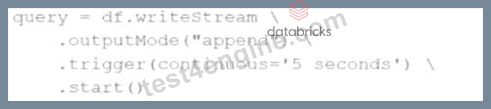
B)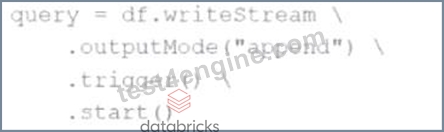
C)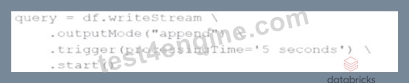
D)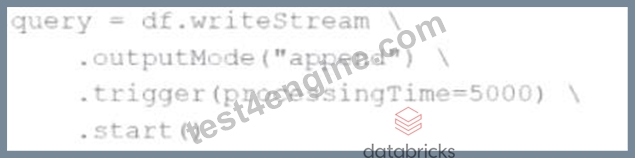
Options:
- A. Uses trigger(processingTime='5 seconds') - correct micro-batch trigger with interval.
- B. Uses trigger(continuous='5 seconds') - continuous processing mode.
- C. Uses trigger() - default micro-batch trigger without interval.
- D. Uses trigger(processingTime=5000) - invalid, as processingTime expects a string.
Answer: A
Explanation:
To define a micro-batch interval, the correct syntax is:
query = df.writeStream \
outputMode("append") \
trigger(processingTime='5 seconds') \
start()
This schedules the query to execute every 5 seconds.
Continuous mode (used in Option A) is experimental and has limited sink support.
Option D is incorrect because processingTime must be a string (not an integer).
Option B triggers as fast as possible without interval control.
Reference:Spark Structured Streaming - Triggers
NEW QUESTION # 43
Which feature of Spark Connect is considered when designing an application to enable remote interaction with the Spark cluster?
- A. It allows for remote execution of Spark jobs
- B. It is primarily used for data ingestion into Spark from external sources
- C. It can be used to interact with any remote cluster using the REST API
- D. It provides a way to run Spark applications remotely in any programming language
Answer: A
Explanation:
Comprehensive and Detailed Explanation:
Spark Connect introduces a decoupled client-server architecture. Its key feature is enabling Spark job submission and execution from remote clients - in Python, Java, etc.
From Databricks documentation:
"Spark Connect allows remote clients to connect to a Spark cluster and execute Spark jobs without being co- located with the Spark driver." A is close, but "any language" is overstated (currently supports Python, Java, etc., not literally all).
B refers to REST, which is not Spark Connect's mechanism.
D is incorrect; Spark Connect isn't focused on ingestion.
Final Answer: C
NEW QUESTION # 44
What is the risk associated with this operation when converting a large Pandas API on Spark DataFrame back to a Pandas DataFrame?
- A. The operation will fail if the Pandas DataFrame exceeds 1000 rows
- B. The conversion will automatically distribute the data across worker nodes
- C. The operation will load all data into the driver's memory, potentially causing memory overflow
- D. Data will be lost during conversion
Answer: C
Explanation:
Comprehensive and Detailed Explanation From Exact Extract:
When you convert a largepyspark.pandas(aka Pandas API on Spark) DataFrame to a local Pandas DataFrame using.toPandas(), Spark collects all partitions to the driver.
From the Spark documentation:
"Be careful when converting large datasets to Pandas. The entire dataset will be pulled into the driver's memory." Thus, for large datasets, this can cause memory overflow or out-of-memory errors on the driver.
Final Answer: D
NEW QUESTION # 45
Given the code: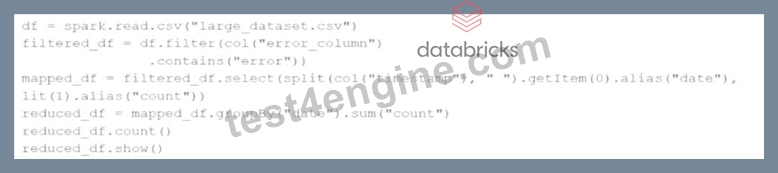
df = spark.read.csv("large_dataset.csv")
filtered_df = df.filter(col("error_column").contains("error"))
mapped_df = filtered_df.select(split(col("timestamp")," ").getItem(0).alias("date"), lit(1).alias("count")) reduced_df = mapped_df.groupBy("date").sum("count") reduced_df.count() reduced_df.show() At which point will Spark actually begin processing the data?
- A. When the count action is applied
- B. When the filter transformation is applied
- C. When the show action is applied
- D. When the groupBy transformation is applied
Answer: A
Explanation:
Spark uses lazy evaluation. Transformations like filter, select, and groupBy only define the DAG (Directed Acyclic Graph). No execution occurs until an action is triggered.
The first action in the code is:reduced_df.count()
So Spark starts processing data at this line.
Reference:Apache Spark Programming Guide - Lazy Evaluation
NEW QUESTION # 46
A data scientist wants each record in the DataFrame to contain:
The first attempt at the code does read the text files but each record contains a single line. This code is shown below: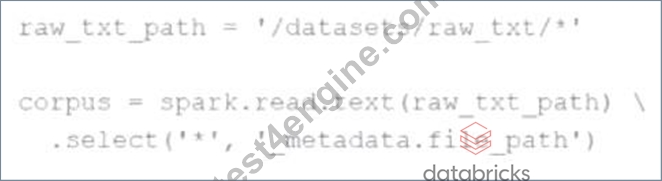
The entire contents of a file
The full file path
The issue: reading line-by-line rather than full text per file.
Code:
corpus = spark.read.text("/datasets/raw_txt/*") \
.select('*','_metadata.file_path')
Which change will ensure one record per file?
Options:
- A. Add the option wholetext=False to the text() function
- B. Add the option wholetext=True to the text() function
- C. Add the option lineSep='\n' to the text() function
- D. Add the option lineSep=", " to the text() function
Answer: B
Explanation:
To read each file as a single record, use:
spark.read.text(path, wholetext=True)
This ensures that Spark reads the entire file contents into one row.
Reference:Spark read.text() with wholetext
NEW QUESTION # 47
A Spark DataFramedfis cached using theMEMORY_AND_DISKstorage level, but the DataFrame is too large to fit entirely in memory.
What is the likely behavior when Spark runs out of memory to store the DataFrame?
- A. Spark stores the frequently accessed rows in memory and less frequently accessed rows on disk, utilizing both resources to offer balanced performance.
- B. Spark splits the DataFrame evenly between memory and disk, ensuring balanced storage utilization.
- C. Spark duplicates the DataFrame in both memory and disk. If it doesn't fit in memory, the DataFrame is stored and retrieved from the disk entirely.
- D. Spark will store as much data as possible in memory and spill the rest to disk when memory is full, continuing processing with performance overhead.
Answer: D
Explanation:
Comprehensive and Detailed Explanation From Exact Extract:
When using theMEMORY_AND_DISKstorage level, Spark attempts to cache as much of the DataFrame in memory as possible. If the DataFrame does not fit entirely in memory, Spark will store the remaining partitions on disk. This allows processing to continue, albeit with a performance overhead due to disk I/O.
As per the Spark documentation:
"MEMORY_AND_DISK: It stores partitions that do not fit in memory on disk and keeps the rest in memory.
This can be useful when working with datasets that are larger than the available memory."
- Perficient Blogs: Spark - StorageLevel
This behavior ensures that Spark can handle datasets larger than the available memory by spilling excess data to disk, thus preventing job failures due to memory constraints.
NEW QUESTION # 48
A Spark application is experiencing performance issues in client mode because the driver is resource- constrained.
How should this issue be resolved?
- A. Switch the deployment mode to local mode
- B. Add more executor instances to the cluster
- C. Increase the driver memory on the client machine
- D. Switch the deployment mode to cluster mode
Answer: D
Explanation:
Comprehensive and Detailed Explanation From Exact Extract:
In Spark's client mode, the driver runs on the local machine that submitted the job. If that machine is resource- constrained (e.g., low memory), performance degrades.
From the Spark documentation:
"In cluster mode, the driver runs inside the cluster, benefiting from cluster resources and scalability." Option A is incorrect - executors do not help the driver directly.
Option B might help short-term but does not scale.
Option C is correct - switching to cluster mode moves the driver to the cluster.
Option D (local mode) is for development/testing, not production.
Final Answer: C
NEW QUESTION # 49
A data engineer is working on the DataFrame: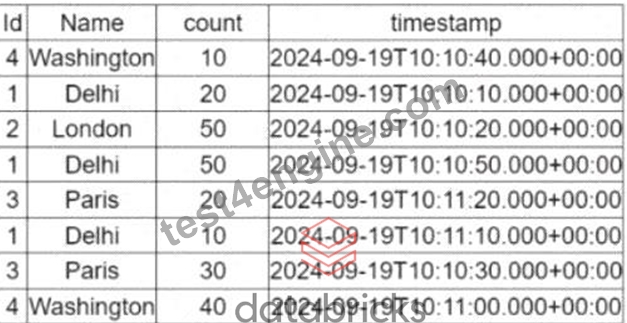
(Referring to the table image: it has columnsId,Name,count, andtimestamp.) Which code fragment should the engineer use to extract the unique values in theNamecolumn into an alphabetically ordered list?
- A. df.select("Name").distinct()
- B. df.select("Name").distinct().orderBy(df["Name"].desc())
- C. df.select("Name").distinct().orderBy(df["Name"])
- D. df.select("Name").orderBy(df["Name"].asc())
Answer: C
Explanation:
Comprehensive and Detailed Explanation From Exact Extract:
To extract unique values from a column and sort them alphabetically:
distinct()is required to remove duplicate values.
orderBy()is needed to sort the results alphabetically (ascending by default).
Correct code:
df.select("Name").distinct().orderBy(df["Name"])
This is directly aligned with standard DataFrame API usage in PySpark, as documented in the official Databricks Spark APIs. Option A is incorrect because it may not remove duplicates. Option C omits sorting.
Option D sorts in descending order, which doesn't meet the requirement for alphabetical (ascending) order.
NEW QUESTION # 50
In the code block below,aggDFcontains aggregations on a streaming DataFrame: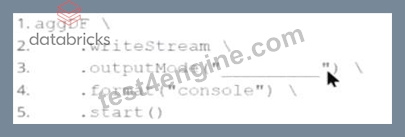
Which output mode at line 3 ensures that the entire result table is written to the console during each trigger execution?
- A. replace
- B. append
- C. aggregate
- D. complete
Answer: D
Explanation:
Comprehensive and Detailed Explanation From Exact Extract:
The correct output mode for streaming aggregations that need to output the full updated results at each trigger is"complete".
From the official documentation:
"complete: The entire updated result table will be output to the sink every time there is a trigger." This is ideal for aggregations, such as counts or averages grouped by a key, where the result table changes incrementally over time.
append: only outputs newly added rows
replace and aggregate: invalid values for output mode
Reference: Spark Structured Streaming Programming Guide # Output Modes
NEW QUESTION # 51
A developer is trying to join two tables,sales.purchases_fctandsales.customer_dim, using the following code:
fact_df = purch_df.join(cust_df, F.col('customer_id') == F.col('custid')) The developer has discovered that customers in thepurchases_fcttable that do not exist in thecustomer_dimtable are being dropped from the joined table.
Which change should be made to the code to stop these customer records from being dropped?
- A. fact_df = cust_df.join(purch_df, F.col('customer_id') == F.col('custid'))
- B. fact_df = purch_df.join(cust_df, F.col('customer_id') == F.col('custid'), 'right_outer')
- C. fact_df = purch_df.join(cust_df, F.col('cust_id') == F.col('customer_id'))
- D. fact_df = purch_df.join(cust_df, F.col('customer_id') == F.col('custid'), 'left')
Answer: D
Explanation:
Comprehensive and Detailed Explanation From Exact Extract:
In Spark, the default join type is an inner join, which returns only the rows with matching keys in both DataFrames. To retain all records from the left DataFrame (purch_df) and include matching records from the right DataFrame (cust_df), a left outer join should be used.
By specifying the join type as'left', the modified code ensures that all records frompurch_dfare preserved, and matching records fromcust_dfare included. Records inpurch_dfwithout a corresponding match incust_dfwill havenullvalues for the columns fromcust_df.
This approach is consistent with standard SQL join operations and is supported in PySpark's DataFrame API.
NEW QUESTION # 52
A data engineer is building an Apache Spark™ Structured Streaming application to process a stream of JSON events in real time. The engineer wants the application to be fault-tolerant and resume processing from the last successfully processed record in case of a failure. To achieve this, the data engineer decides to implement checkpoints.
Which code snippet should the data engineer use?
- A. query = streaming_df.writeStream \
.format("console") \
.outputMode("append") \
.start() - B. query = streaming_df.writeStream \
.format("console") \
.option("checkpoint", "/path/to/checkpoint") \
.outputMode("append") \
.start() - C. query = streaming_df.writeStream \
.format("console") \
.outputMode("append") \
.option("checkpointLocation", "/path/to/checkpoint") \
.start() - D. query = streaming_df.writeStream \
.format("console") \
.outputMode("complete") \
.start()
Answer: C
Explanation:
Comprehensive and Detailed Explanation From Exact Extract:
To enable fault tolerance and ensure that Spark can resume from the last committed offset after failure, you must configure a checkpoint location using the correct option key:"checkpointLocation".
From the official Spark Structured Streaming guide:
"To make a streaming query fault-tolerant and recoverable, a checkpoint directory must be specified using.
option("checkpointLocation", "/path/to/dir")."
Explanation of options:
Option A uses an invalid option name:"checkpoint"(should be"checkpointLocation") Option B is correct: it setscheckpointLocationproperly Option C lacks checkpointing and won't resume after failure Option D also lacks checkpointing configuration Reference: Apache Spark 3.5 Documentation # Structured Streaming # Fault Tolerance Semantics
NEW QUESTION # 53
Which configuration can be enabled to optimize the conversion between Pandas and PySpark DataFrames using Apache Arrow?
- A. spark.conf.set("spark.sql.execution.arrow.enabled", "true")
- B. spark.conf.set("spark.sql.arrow.pandas.enabled", "true")
- C. spark.conf.set("spark.sql.execution.arrow.pyspark.enabled", "true")
- D. spark.conf.set("spark.pandas.arrow.enabled", "true")
Answer: C
Explanation:
Comprehensive and Detailed Explanation From Exact Extract:
Apache Arrow is used under the hood to optimize conversion between Pandas and PySpark DataFrames. The correct configuration setting is:
spark.conf.set("spark.sql.execution.arrow.pyspark.enabled", "true")
From the official documentation:
"This configuration must be enabled to allow for vectorized execution and efficient conversion between Pandas and PySpark using Arrow." Option B is correct.
Options A, C, and D are invalid config keys and not recognized by Spark.
Final Answer: B
NEW QUESTION # 54
......
Actual Questions Answers Pass With Real Associate-Developer-Apache-Spark-3.5 Exam Dumps: https://troytec.test4engine.com/Associate-Developer-Apache-Spark-3.5-real-exam-questions.html